|
Like any other hobby or profession, orchestral music
comes with its own unique vocabulary. Here are some terms which might be
unknown or confusing to some players. This list does not include terms
unique to particular instruments, nor does it try to define basic terms
used in reading music. Rather, the intent is to define words which are
commonly used in rehearsals and which might be unfamiliar to
those who haven't played in a group or with a conductor.
|
| |
- Measures and Sections of the
Music
- Measure Arithmetic
- Pickup
- "Repeats are good" (phrase)
- Top
- Counting and/or Conducting Issues
- "Bar for nothing" (phrase)
- Downbeat
- Upbeat
- "In 1" or "In 3" (phrase)
- "In 2" or "In 4" (phrase)
- "In 8" (phrase)
- "In groups" (phrase)
- Subdivide
- Musical Style
- Dot
- Double-Dot
- Line
- Nothing
- Sections of the Orchestra
- Brass
- Strings
- Woodwinds
- Percussion
- Winds
- Upper Woodwinds
- Upper Strings
- Lower Strings
- Firsts
- Seconds
- Miscellaneous Terms
- Attacca
- Concert (regarding pitch)
- Tutti
|
Measures and
Sections of the Music
|
| |
- Measure Arithmetic
(the phrase "measure arithmetic" isn't commonly used,
but the concept of measure arithmetic is very common)
- A phrase such as "4 after A" refers to a particular measure
in the music -- it suggests we count to the 4th bar past the
measure displaying rehearsal mark A. But sometimes there can
confusion about whether the measure with the rehearsal mark is
counted as "1" or not. Musicians actually use two different
counting methods, whether they're conscious of it or not,
depending how big the number of measures is. For small numbers (e.g.
< 3) , the first measure is usually not counted; but for larger
numbers it is. The figure below illustrates these counting
methods, as well as an alternate form that is considered more
clear.
 |
Three forms for describing measure
position relative to a rehearsal mark: For small numbers of
measures (e.g. 1 or 2), the measure of the
rehearsal mark is counted as zero. For larger numbers (e.g.,
4 or more) the first measure is counted as one. This can
lead to confusion for intermediate spans, as shown above. To
avoid confusion, one can use the alternate form (e.g.
"3rd bar of...") which corresponds to the large-number form
but is considered less confusing. |
- Pickup
- Often a melody or theme begins part-way through the measure.
Sometimes the entire piece starts this way. Rather than showing
rests at the beginning of the first measure in this case, the rests
are omitted and the notes which comprise the partial measure are
called "pickup" notes. If more than one note appears before the
first full measure, the set of these notes together is called the
"pickup."
- Often in rehearsal it is common to start playing a section of
the music "with the pickup" rather than on the first beat of a
particular measure.

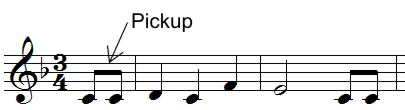
A pickup beat (the two opening C eighth
notes) at the beginning of Happy Birthday . |
- "Repeats are good"
(phrase)
- Sometimes when there are one or more repeated sections (see
this Wikipedia
article) in the music, the conductor may elect to skip the
repeat(s). "Skipping the repeats" means to play the repeated section
or sections just once, rather than twice (or whatever the indicated
number is). The phrase "repeats are good" means that these sections
are to be repeated, as printed.
- Top
- The beginning of the piece, or the beginning of the movement.
Used in phrases such as "lets take it from the top."
|
| |
|
Counting and/or
Conducting Issues
|
|
- "Bar for nothing"
(phrase)
- Typically the conductor will give one or two preparatory
beats before the music begins. The phrase "bar for nothing" (or
"measure for nothing") indicates the conductor will show one
entire measure before the music starts. (The preparatory measure
may include a
pickup.)
- Downbeat
- The first beat of a measure (beat 1).
- Upbeat
- The last beat of a measure (e.g., in a 3/4 measure the
upbeat is beat 3).
- "In
1" or "In 3" (phrase)
- The conductor's beats usually correspond to the beat pattern
printed in the music. For example, music in 4/4 time will usually be
conducted with four beats per measure, and each beat will represent
a quarter note. Music in 3/4 time (sometimes called "waltz time")
can be conducted in two ways, however -- "in 3" with three beats per
measure, again where each beat represents a quarter note, or "in 1"
where each beat represents a dotted half note and hence an entire
measure.
- It's fairly common for conductors to switch from beating "in 3"
to "in 1" or vice versa, depending on the tempo or other factors.
This is often done without telling the players, since it's usually
easy to see which beat pattern is being used.
- Treatment of three written beats as one combined beat is central
to the concept of "compound time." See
this Wikipedia
article for more information on compound time and other advanced
aspects of time signatures.
|
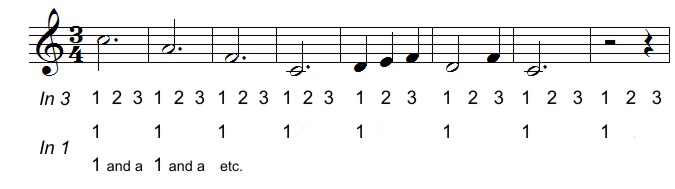
Daisy Bell
(the "bicycle built for two" song) counted in 3
and in 1, as well as in subdivided 1.
|
- "In 2" or "In 4" (phrase)
- Similarly to the in 3/4 "in 1" example discussed
above, sometimes 4/4 measures are conducted
"in 2" rather than "in 4", and sometimes cut time (2/2) measures are
conducted "in 4" rather than "in 2." These exceptions are somewhat
less common than the 3 vs. 1 case, so the conductor is more
likely to tell the players if a different beat pattern is being
used.
|
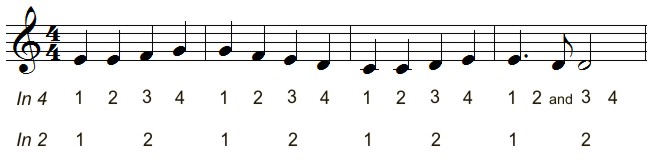
Ode to Joy
(from Beethoven's 9th symphony) counted in 4
and
in 2.
|
- "In 8" (phrase)
- In very slow music, especially in early classical works, 4/4
time is often conducted in a subdivided four. By convention, the
term "in 8" is used to indicate this. So "in 8" really means "in a
subdivided 4," and even music actually written in 8/8 time is
conducted in subdivided 4.
- Since "in 8" does not indicate an eight-beat conducting pattern,
the term is inconsistent relative to "in 3" etc. as described
above.
|
Opening measures of Handel's Messiah (first
movement)
in 8, which is actual just subdivided 4.
|
- "In Groups" (phrase)
- In very fast music, sometimes entire measures are conducted in
one beat. This is sort-of an extension of counting in 1 as described
above, but a beat pattern is conducted to
group several measures together.
|
The Sorcerer's Apprentice conducted in
groups of 3. Each measure is counted as one beat, and
three measures together are counted as a larger measure of three
beats.
|
- Subdivide
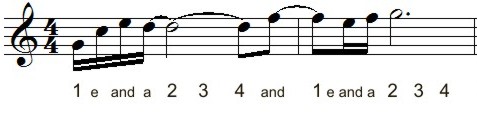
- To assist in counting rhythms both players and conductors often
divide the beats into smaller but equal divisions, hence the term
"subdivide." The commonly used syllables for subdivision are shown
below.
|
| |
|
|
|
| |
- Dot
- In rehearsal, the phrase "dots on the notes" generally refers to
staccato dots, not to the duration-increasing dot of, for
example, a dotted quarter note. (Compare to line.)
- Double-Dot
- Sometimes, especially in early classical works, it's common to
play so-called "dotted rhythms" (e.g. dotted quarter note
followed by eighth note, or dotted eighth followed by a sixteenth
note) as if they were double-dotted (e.g. double-dotted
quarter followed by sixteenth, or double-dotted eighth followed by a
thirty-second note). For example, the passage shown in the upper
part of this figure is usually played as if it were
written in the lower form:
|
Opening measures of Handel's Messiah
(first movement) shown (a) as
written, and (b) as played in a
double-dotted
style.
|
- Line
- In rehearsal, "lines on the notes" refers to tenuto
lines, that is, an indication to stress or lengthen the notes.
(Compare to
dot.)
- Nothing
- In rehearsal, "nothing" typically means to play as softly as
possible. Typically used in a phrase such as "Strings mezzoforte,
then nothing at Letter A."
|
| |
|
Sections of the
Orchestra
|
| |
Most of these are self-explanatory, but "winds"
is often used in two different ways:
- Brass
- Trumpets, ("French") horns, trombones, and tuba. Also includes size
variants within these families (e.g. piccolo trumpet, bass
trombone, etc.).
- Strings
- Violins, violas, cellos, and basses. Note that violins are
typically divided into the "first violin" and "second violin"
sections.
- Woodwinds
- Flutes, oboes, clarinets, and bassoons. Also includes size
variants within these families (e.g., piccolo, English
horn, bass clarinet, etc.).
- Percussion
- All instruments which normally make their sound when struck.
Categories includes drums (snare, bass, etc.) as well as timpani,
melodic percussion (glockenspiel, xylophone, marimba, etc.) and a
wide variety of others (cymbals, triangle, claves, etc.).
- Winds
- Generally refers to a combination of the woodwind and brass
sections of the orchestra. But, confusingly, the term sometimes is
used as a shortcut for "woodwinds," thus not including the
brass instruments (typically in the phrase "winds and brass").
- Upper Woodwinds
(sometimes "upper winds")
- Typically flutes, oboes, and clarinets
- Upper Strings
- Typically violins (I and II) and violas
- Lower Strings
- Typically cellos and basses
- Firsts
- First violins
- Seconds
- Second violins
- Horns
- French horns
|
| |
|
|
|
| |
- Attacca
- Italian word meaning "attack"
An indication at the
end of a movement (either printed in the music or from the
conductor) that the following movement begins immediately or with
only a very short pause.
- Concert (regarding
pitch)
- Refers to absolute pitch as named without regard to
transposition. For example, an instrument "in A" sounds the pitch
concert A
when playing a written C. See this
tutorial on
transposition for more information.
- Tutti
- Italian word meaning "all" or "together"
In
rehearsal, it can mean either:
- 1. a direction for everyone to play (perhaps after some time had
been spent rehearsing a few instruments alone), or
2. a section
of the piece where everyone (or nearly everyone) plays together --
for example, the point at which the whole orchestra plays again
after a cadenza.
|